
How to Choose Stainless Steel Sculpture for Your Private Garden?
From my experience working with private garden sculpture projects, I have learned one important thing: choosing a garden sculpture is not only about whether it looks beautiful. I am Linda, and when I discuss a sculpture with a villa owner, landscape designer, or private collector, I always look at the garden size, style, viewing angle, weather, safety, material, finish, and long-term maintenance together.
A sculpture may look perfect in a catalog, but it can feel too small in a large lawn, too strong beside soft planting, or too reflective in the wrong sunlight. A good stainless steel garden sculpture should feel natural in the space. It should also be practical enough to stay outdoors for many years. In this guide, I will explain how to choose a sculpture for your garden step by step.
Start with Your Garden Size
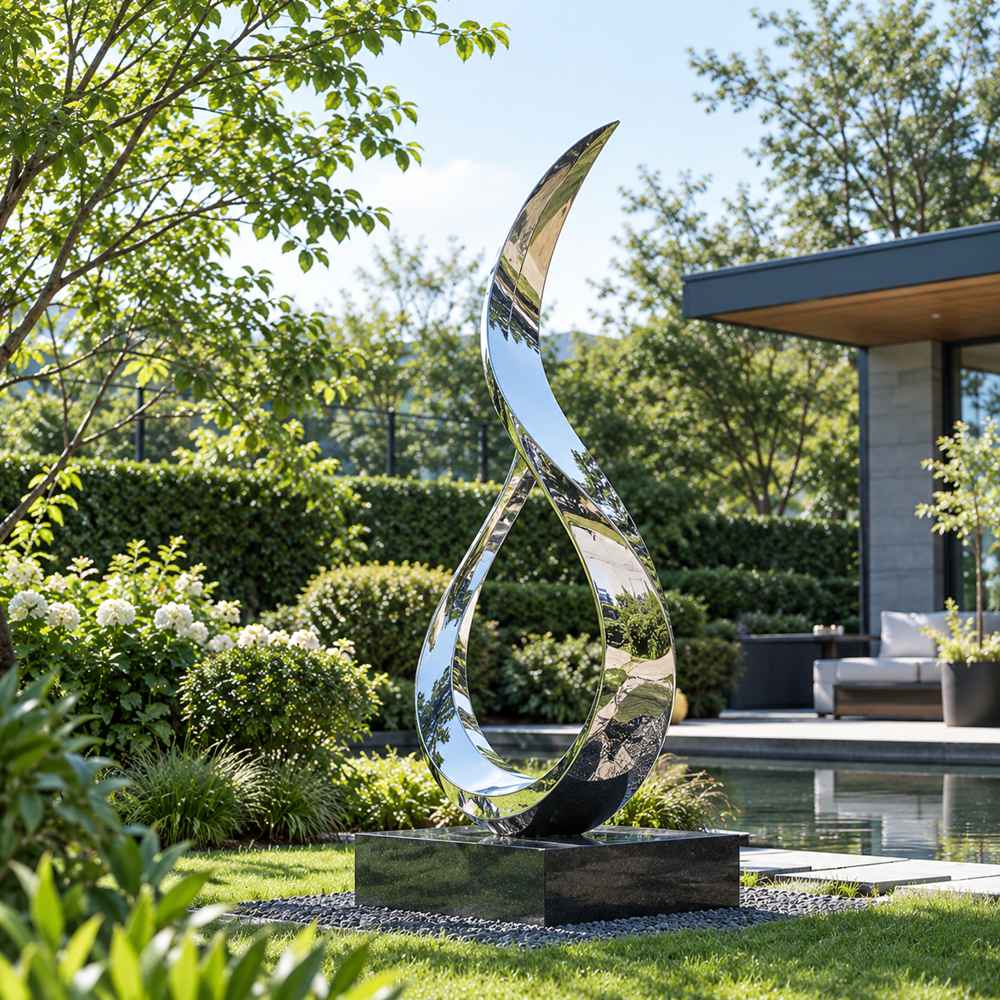
The first thing I check is garden size. Scale affects almost every decision: sculpture height, shape, visual weight, base design, and installation method.
A sculpture that is too small may disappear in the landscape. A sculpture that is too large may block views or make the garden feel crowded. I usually suggest thinking about the garden in three simple size groups.
| Garden Size | Typical Area | Suggested Sculpture Size | Practical Advice |
|---|---|---|---|
| Small garden or courtyard | Under 100 m² | 0.6–1.2 m high | Choose one focused piece. Avoid very wide or heavy forms. |
| Medium private garden | 100–500 m² | 1.2–2.5 m high | A standing sculpture, sphere, abstract form, or water feature can work well. |
| Large villa garden or estate | Over 500 m² | 2.5 m and above | Consider a landmark piece, grouped sculptures, or a custom large-scale design. |
These numbers are not fixed rules. They are useful starting points. In my project discussions, I also ask where the sculpture will be viewed from. A piece seen from a living room window may need a different size than one viewed from a long garden path.
For a small courtyard, I often prefer a compact sculpture with a clear outline. For a large lawn, I look for stronger height, wider volume, or a polished surface that catches light from a distance.
Match the Sculpture Style with Your Garden Design
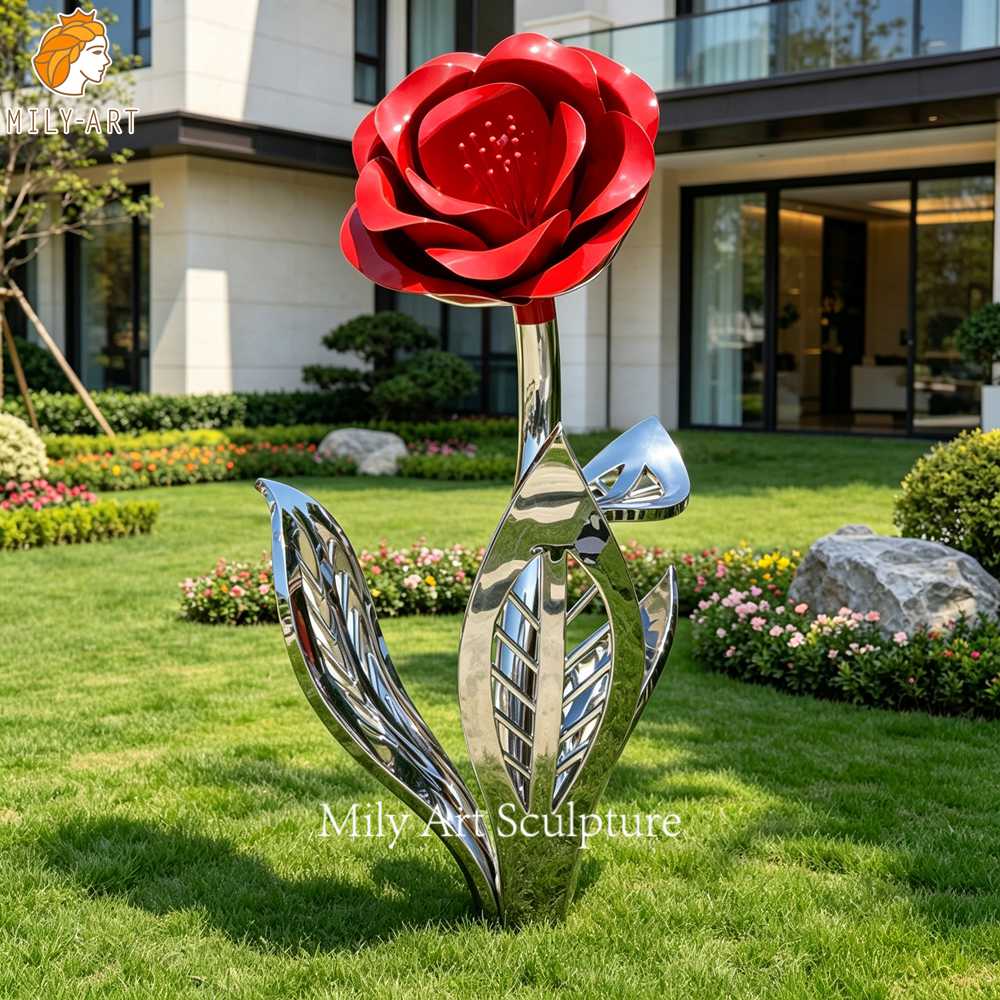
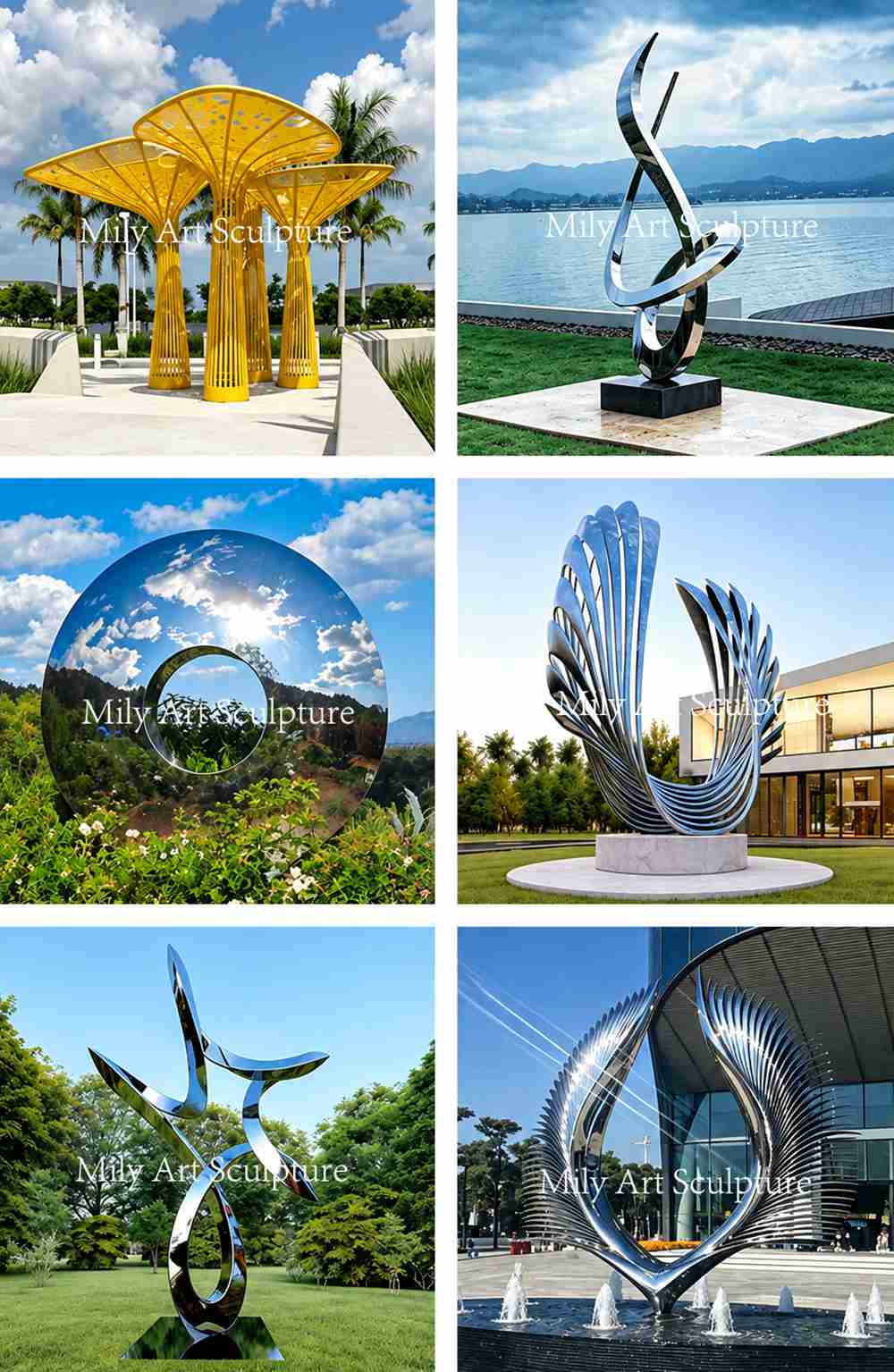
A sculpture should not fight with the garden style. It should add focus while still belonging to the space. Stainless steel is flexible because it can be mirror polished, brushed, painted, or shaped into organic or geometric forms.
Here is a simple way to match garden styles with sculpture directions.
| Garden Style | Suitable Sculpture Style | Recommended Finish | Why It Works |
|---|---|---|---|
| Modern minimalist garden | Geometric, abstract, clean curves | Mirror polish or brushed satin | Matches straight lines, open space, and simple planting. |
| Natural or woodland garden | Organic forms, leaf shapes, flowing lines | Brushed satin or soft mirror polish | Blends better with plants, stone, and water. |
| Luxury villa garden | Large abstract centerpiece, sphere, ribbon form | 8K mirror polish or custom color paint | Creates a strong visual focal point. |
| Zen or courtyard garden | Simple vertical form, ring, circle, balance-themed design | Brushed satin or dark painted finish | Supports calm, quiet composition. |
| Resort-style garden | Dynamic abstract sculpture or water sculpture | Mirror polish, satin, or painted finish | Adds movement and photo value. |
When I review a garden plan, I do not only look at the sculpture image. I check paving, planting, wall color, lighting, pool position, and building style. This helps me suggest a form that feels connected to the full environment.
Think About Placement and Outdoor Environment
Placement can make a good sculpture look excellent. It can also create problems if not planned early.
I usually ask these questions before confirming a sculpture position:
| Placement Factor | What to Check | Why It Matters |
|---|---|---|
| Main viewing angle | Window, terrace, entrance, garden path | The sculpture should face the most important viewpoint. |
| Sunlight | Morning sun, afternoon sun, strong glare | Mirror surfaces can reflect light strongly. |
| Background | Plants, wall, sky, water, stone | A clear background helps the sculpture stand out. |
| Walking space | Distance around the sculpture | People should move safely around it. |
| Ground condition | Soil, paving, concrete foundation | Large sculptures need stable support. |
| Water or pool nearby | Splash, humidity, chemicals | Material grade and finish choice become more important. |
| Wind exposure | Open lawn, rooftop, coastal area | Internal structure and anchoring must be planned. |
In a private garden, I often prefer placing sculpture where it creates a visual “pause.” This can be at the end of a path, beside a pool, near an entrance, or in the center of a lawn. A sculpture does not always need to sit in the middle. Sometimes an off-center position looks more natural and more elegant.
If the garden has night lighting, I also suggest planning light direction early. Stainless steel can create beautiful highlights under warm garden lights, but strong direct light may create glare on mirror surfaces.
Why I Often Recommend Stainless Steel for Private Gardens
For outdoor sculpture, material choice is not only about appearance. It affects weather resistance, maintenance, finish options, production cost, and service life.
I often recommend stainless steel for private gardens because it gives a clean contemporary look and performs well outdoors when the right grade and fabrication method are used.
| Material Feature | Why It Helps in a Garden |
|---|---|
| Corrosion resistance | Suitable for long-term outdoor exposure when the correct grade is selected. |
| Strong structure | Works well for both small sculptures and large custom forms. |
| Flexible shaping | Can be made into abstract, geometric, organic, or figurative designs. |
| Many finish options | Mirror polish, brushed satin, painted color, and mixed finishes are possible. |
| Low daily maintenance | Easier to clean than many porous outdoor materials. |
For stainless steel garden sculpture, two common grades are 304 and 316 stainless steel. In simple terms, 304 stainless steel suits many normal outdoor environments. 316 stainless steel has stronger corrosion resistance and is often better for coastal areas, poolside areas, or humid environments.
If your garden is near the sea, close to a swimming pool, or exposed to heavy humidity, I normally suggest reviewing 316 stainless steel carefully. You can read more in this related guide: 304 vs 316 Stainless Steel for Outdoor Sculpture.
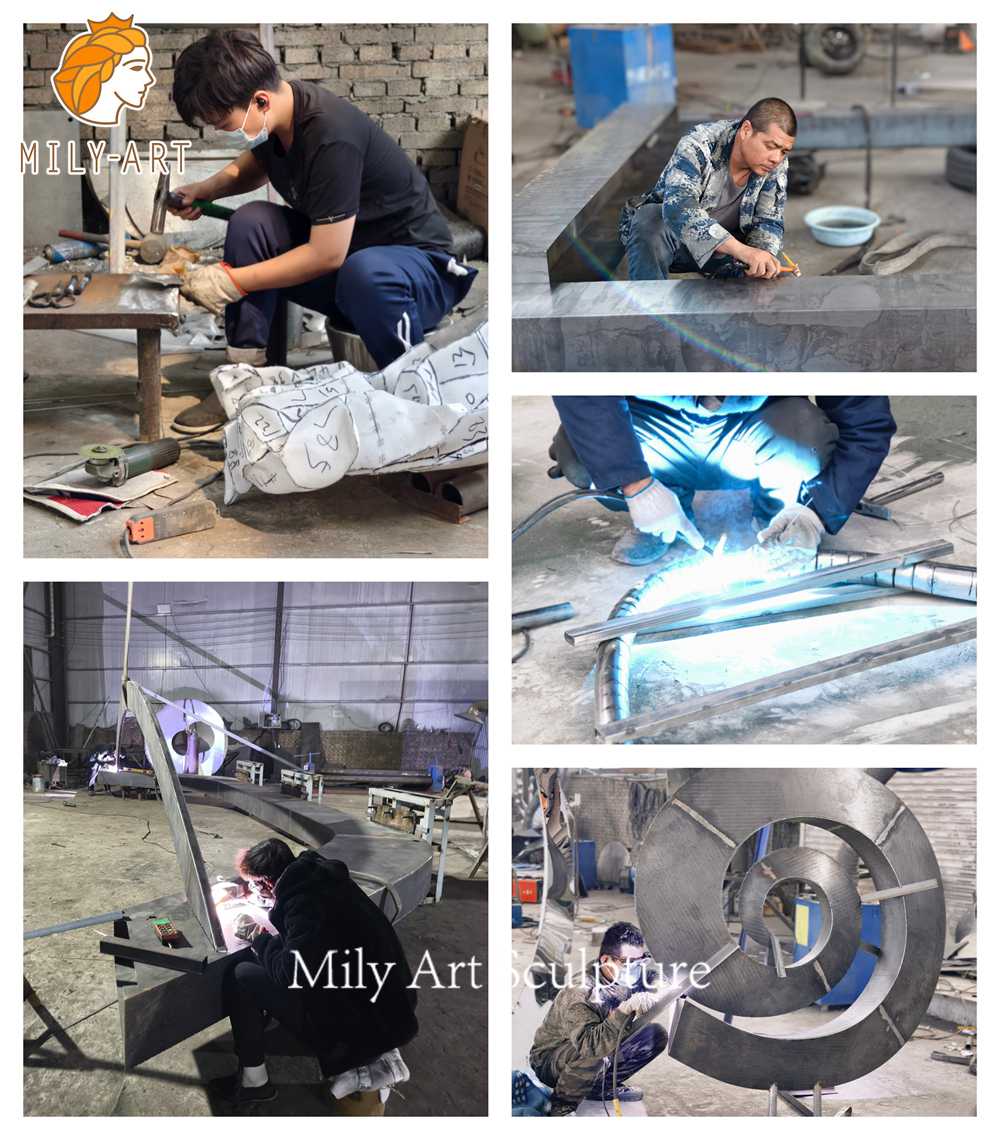
Mily Metal Sculpture was founded in 1994 in Quyang, Hebei, known as China’s Sculpture Capital. The factory designs and manufactures custom stainless steel and Corten steel sculptures, with in-house processes including 3D modeling, CNC cutting, hand-finishing, and premium surface treatment. For a private garden buyer, this matters because sculpture quality depends on both design control and fabrication control.
Choose the Right Surface Finish
Surface finish changes the whole feeling of a stainless steel sculpture. It also affects cleaning, reflection, and how strongly the sculpture stands out in the garden.
Here are the common choices I discuss with garden clients.
| Finish Type | Appearance | Best For | Key Consideration |
|---|---|---|---|
| 8K mirror polish | Highly reflective, bright, luxury look | Modern villas, lawns, poolside features | Reflects sunlight, plants, sky, and people clearly. |
| Brushed satin | Soft linear texture, less reflective | Courtyards, natural gardens, quiet spaces | Shows fewer strong reflections than mirror polish. |
| Painted finish | Custom color, smooth surface | Branded landscapes, themed gardens, bold design | Color should match architecture and planting. |
| Mixed finish | Combines mirror, satin, or color | Custom artistic designs | Needs careful design control to avoid visual conflict. |
If you are comparing finish options, this article may help: Stainless Steel Sculpture Surface Finishes Explained.

Plan the Custom Design and Approval Process
If you choose a custom garden sculpture, the approval process is very important. A sculpture is not a small decoration that you can easily move or replace. The shape, size, finish, base, and installation method should be confirmed before production.
From my experience, a clear process saves time and avoids misunderstanding.
| Step | What Happens | What I Suggest You Confirm |
|---|---|---|
| 1. Concept discussion | Share garden photos, plan, size, and style preference | Main purpose, location, preferred feeling |
| 2. Design proposal | Sketch, reference image, or 3D model is developed | Shape, height, width, viewing angles |
| 3. Material and finish choice | Stainless steel grade and surface finish are selected | 304 or 316, mirror, satin, paint, or mixed finish |
| 4. Structure planning | Internal frame, base, and anchoring are considered | Wind exposure, foundation, installation conditions |
| 5. Production | Cutting, welding, grinding, polishing, and finishing | Production updates and quality checkpoints |
| 6. Packing and shipping | Export-grade packing and shipping method are arranged | Delivery term, destination, unloading plan |
| 7. Installation | Sculpture is fixed on site | Foundation, tools, lifting equipment, installer support |
Mily Metal Sculpture offers one dedicated project manager per client and supports design-to-shipping service, including export-grade packaging and global shipping terms such as FOB, CIF, DAP, and DDP. As a buyer, you do not need to know every technical detail, but you should know who is responsible for each stage.
Do Not Ignore Maintenance
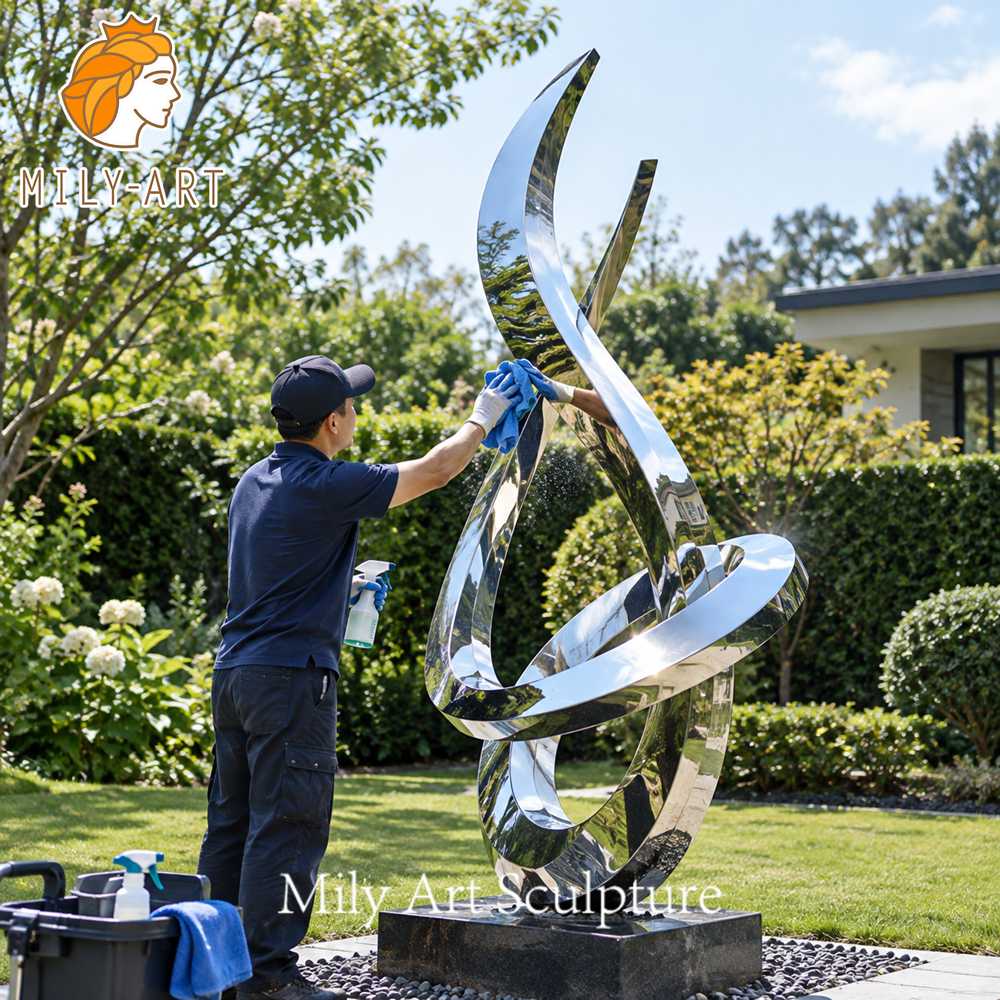
Stainless steel is low-maintenance, but it is not “no-maintenance.” Outdoor dust, rain marks, fingerprints, pool chemicals, salt air, and bird droppings can affect the surface over time.
For private garden sculptures, I usually give simple maintenance advice.
| Maintenance Task | Suggested Action | Why It Matters |
|---|---|---|
| Regular cleaning | Use clean water and a soft cloth | Removes dust and surface dirt. |
| Mild detergent | Use only when needed | Helps clean fingerprints or light stains. |
| Avoid hard tools | Do not use steel wool or sharp scrapers | Prevents scratches on polished surfaces. |
| Check nearby chemicals | Watch pool water, fertilizer, and cleaning agents | Some chemicals can damage the surface. |
| Inspect joints and base | Check after storms or seasonal changes | Helps find movement or stains early. |
For mirror polished sculptures, scratches are more visible. For brushed satin finishes, cleaning should follow the direction of the brushed lines. If the sculpture is installed near the coast or a pool, maintenance should be more regular. You can read more here: How to Prevent Rust on Stainless Steel Sculpture.
Budget Factors to Consider
I do not suggest choosing a garden sculpture by price alone. Two sculptures may look similar in a small picture but differ greatly in material thickness, internal structure, welding quality, polishing time, packing, and installation support.
The main cost drivers usually include:
| Cost Factor | Why It Changes the Price |
|---|---|
| Size | Larger sculptures need more material, labor, structure, and packing. |
| Shape complexity | Curved, twisted, or seamless forms require more skilled fabrication. |
| Stainless steel grade | 316 usually costs more than 304 but may be better for harsh environments. |
| Surface finish | 8K mirror polish takes more hand-finishing time than simple finishes. |
| Internal structure | Outdoor large sculptures need safe engineering and anchoring. |
| Packing and shipping | Large export crates and international freight affect total cost. |
| Installation needs | Heavy pieces may require lifting equipment and site preparation. |
If you ask for a quotation, I suggest preparing the sculpture size, reference design, installation location, preferred finish, and destination country. This makes the quotation more accurate.
Final Thoughts from Linda
Choosing a stainless steel sculpture for your private garden is a design decision and a practical investment. I always suggest starting with the garden size, then matching the style, checking the placement, choosing the right stainless steel grade, selecting a suitable finish, and planning maintenance from the beginning.
A good sculpture should not only attract attention on the first day. It should continue to feel right as the garden grows, the seasons change, and the owner lives with it every day.
If you are planning a villa garden, courtyard, lawn, poolside area, or private estate project, you can explore suitable design directions here: Private Garden Sculpture Collection. I am happy to help you think through the size, material, finish, and custom details before production begins.

I’m Linda, and I’ve been living and breathing stainless steel sculptures for over a decade — which sounds more intense than it is, I promise.
As Sales Director at Mily Statue, I spend my days helping clients around the world turn their ideas into real, lasting works of art. From a small garden piece for a private home to a multi-story installation for a city plaza, I’ve seen projects of every scale and style — and I still get genuinely excited when a new brief lands in my inbox.
When I’m not talking sculptures, I’m probably exploring somewhere new, hunting for good coffee, or sharing something beautiful I stumbled across. Life’s too short not to notice the details.
Got a project in mind? Let’s talk.
Share this article

Written by
LindaI'm Linda, and I've been living and breathing stainless steel sculptures for over a decade — which sounds more intense than it is, I promise. As Sales Director at Mily Statue, I spend my days helping clients around the world turn their ideas into real, lasting works of art. From a small garden piece for a private home to a multi-story installation for a city plaza, I've seen projects of every scale and style — and I still get genuinely excited when a new brief lands in my inbox. When I'm not talking sculptures, I'm probably exploring somewhere new, hunting for good coffee, or sharing something beautiful I stumbled across. Life's too short not to notice the details. Got a project in mind? Let's talk.
Related Articles
Why Stainless Steel Sculptures Rust And How to Prevent It
Yes, stainless steel can rust. It is known for rust resistance, not rust immunity. From my experience working...
How to clean stainless steel sculpture?
<div id="container" class="split-container"> <div id="preview" class="column preview-pane"> <div id="preview-wrapper"> <div id="output" class="content markdown-body"> Stainless steel sculptures have become...
Stainless Steel Sculpture Fabrication: How Are Sculptures Made?
Stainless steel sculptures can range from small decorative pieces to large public artworks. Although the finished surface may...